MODO REDES
of being and doing
Maré during the pandemic
¿WHAT IS THIS MATERIAL??
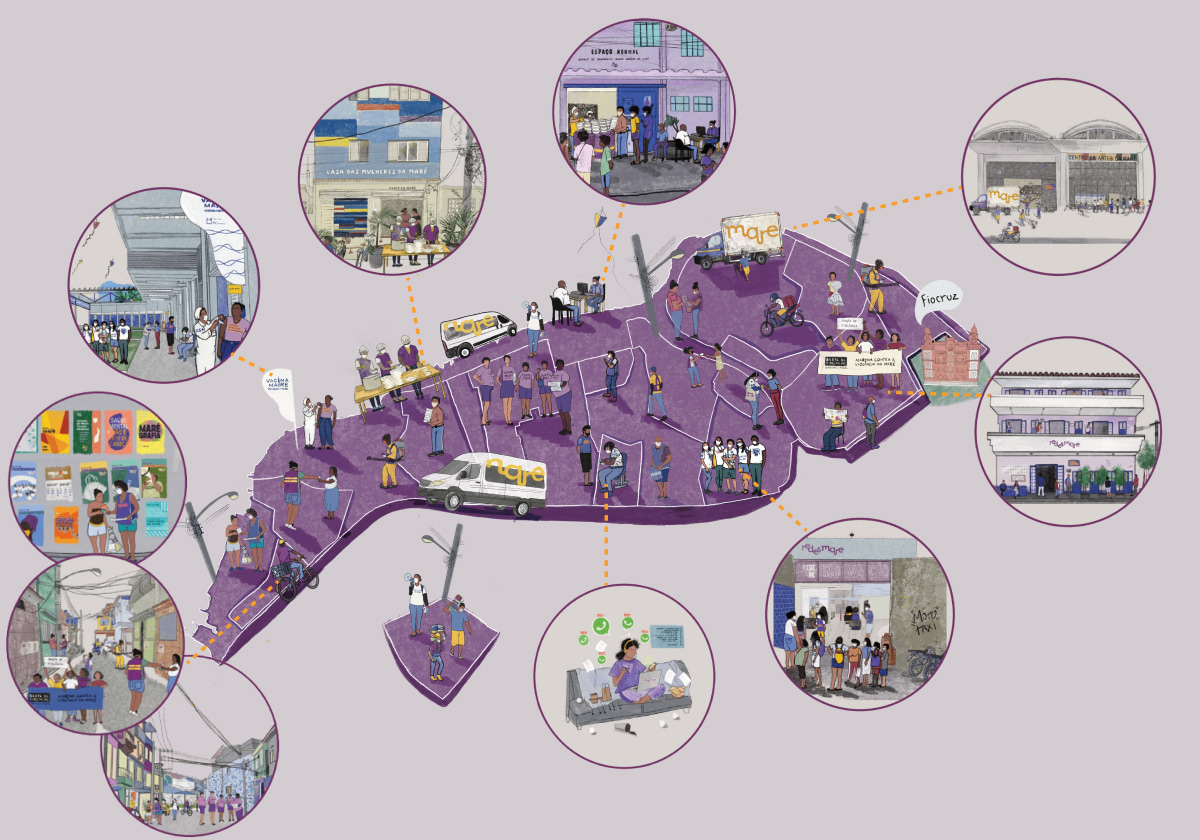
This is an affective cartography of the methodology developed and applied by Redes da Maré during the pandemic. This material is the result of reflections on lived experiences, aiming to transform the organization’s practices into collective and shared knowledge. For five months, a team traveled through the territory, analyzed documents, and listened to over 70 people involved in the actions of the campaign “Maré Says No to Coronavirus”. The guiding questions were: How did Redes da Maré create the campaign? What experiences and accumulated knowledge throughout its history were fundamental in facing the urgencies imposed by the pandemic? The answers emerged from a deep look at the institution’s trajectory and the campaign’s actions. This cartography consists of texts and images that seek to illustrate the actions, emotions, and identity of Redes da Maré.
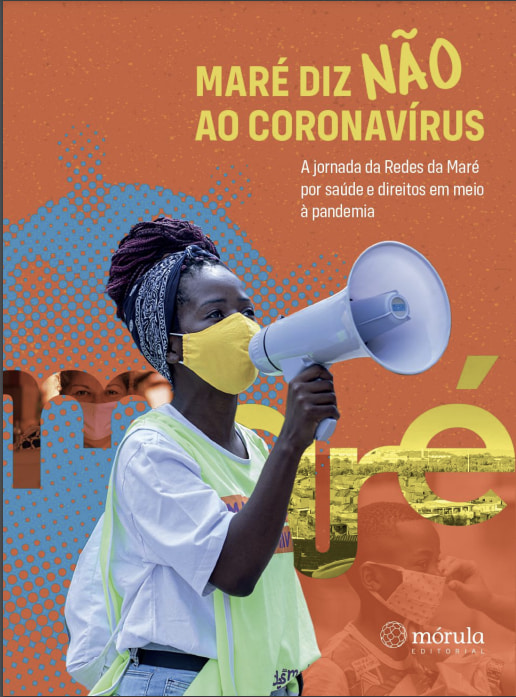
In 2021, Redes da Maré had already published the book Maré Says No to Coronavirus: The Journey of Redes da Maré for Health and Rights in the Midst of the Pandemic, still in the heat of the experiences and actions carried out by “Maré Says No to Coronavirus” campaign. In this new phase, the goal was to deepen the reflections initiated in the book.
The materials presented here aim to go beyond the achievements, seeking to identify the connecting points between the history of Redes da Maré, the “living methodologies” created throughout its trajectory, and those used to respond to the challenges of the pandemic.
- OBJECTIVE OF THE SYSTEMATIZATION
- STAGES OF EXECUTION
The goal of systematization was to understand elements of its history, whose accumulated knowledge over time has been constantly recreated to address emergencies and challenging contexts. The questions guiding the systematization were:
- How did Redes da Maré manage, in such a short time, to create a campaign with different action fronts and such wide-reaching impact?
What experiences and accumulated knowledge throughout its history allowed it to face the urgencies imposed by the COVID-19 pandemic?
The systematization began at the end of February 2022 and continued until July. The work was carried out in four stages:
- Initial mapping;
- Alignment of the proposal and expectations;
- Fieldwork;
- Production of syntheses and creation of products.
This work was based on a deep examination of the organization's trajectory and the campaign's actions, prioritizing listening and gathering the various perceptions and feelings of the "weavers," as the institution's workers are called.
We hope this material allows for a deeper understanding of Redes da Maré and its way of being and acting from its collectivity, strength, challenges, and contradictions lived in motion within the territory.
Access other materials that are part of this systematization process here:
ABOUT MARÉ
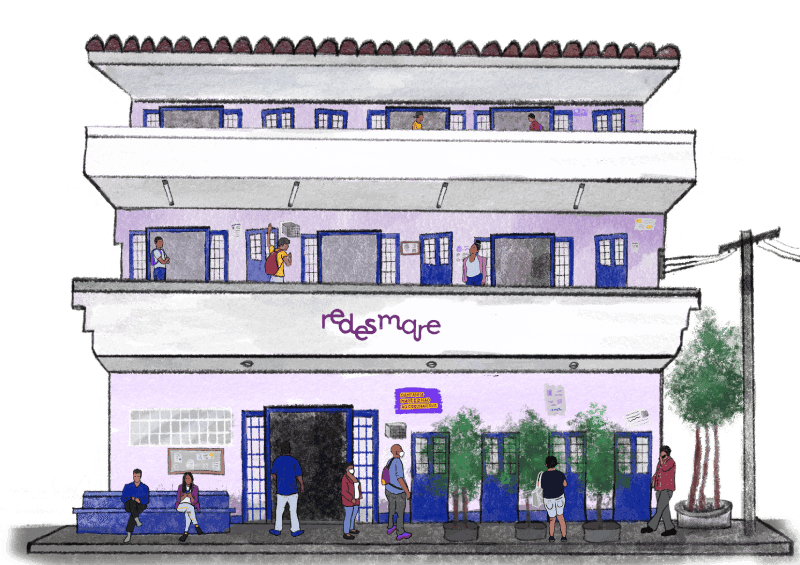
Formalized as an institution in 2007, Redes da Maré is a civil society organization that seeks to guarantee the rights of the residents of the Maré favela complex. Its founders have been involved in collective actions in the territory since the 1980s. Throughout its history, Redes da Maré has built and strengthened residents’ associations and mobilized struggles for territorial development. Redes da Maré was born and expanded through the fight for rights, with an emphasis on the right to education, starting with its first project, the Community Pre-College Preparation Course.
The organization operates through the articulation, mobilization, and production of knowledge about the territory. In this way, it creates initiatives aimed at serving the population and ensuring effective public policies.
The institution seeks to contribute to reducing inequalities in the favela, a place stigmatized by its social and racial origins, and to transforming this reality, with a focus on work with children, women, and the leadership of the residents. Numerous projects have been developed, in which 5,800 people participated in 2021, involving courses, services, and activities. The projects are carried out in 10 facilities and beyond, involving around 300 professionals organized into thematic areas. The work is supported by various partnerships: there are more than 100 supporters and institutional partners, as well as 70 partnerships in the territory, including social organizations, residents’ associations, and public institutions.
PATHS AND LESSONS IN HISTORY
- Community Movements in the 1980s
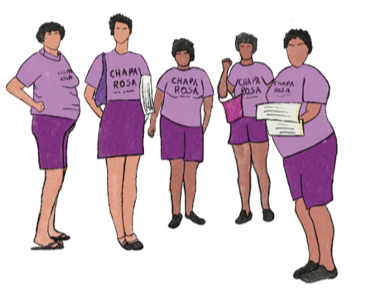
- Residents’ Association: Chapa Rosa
- Community Pre-College Course, etc.
- Institutionalization of Redes da Maré
- Project “Criança Petrobrás”
- Inauguration of the Maré Arts Center (CAM)
- Project “The Maré We Want”
- Public Security Conference
- Creation of the Maré de Notícias newspaper
- Beginning of the Harm Reduction Project
¡TERRITORY AS STARTING AND ENDING POINT!
Redes da Maré’s actions are based on listening to the residents and producing qualified knowledge about the local reality. Long-standing partnerships and connections, both inside and outside the territory, pave the way for influencing public policies and other pathways towards defending rights. It can be said that this way of acting is shaped into a creative and evolving methodology, made and remade collectively through the engagement of those who build it. The territory is both the starting and the ending point.
Along this path, Redes da Maré gains momentum through an intense process of formation for those who weave its threads and the creation of physical spaces with open doors for residents. This approach generates narratives that celebrate the power of the favelas, expressed throughout the territory, from street conversations to institutional communication efforts. The development of areas of focus and projects is the means to achieve rights that have been historically neglected. The areas of focus are: Education; Art, Culture, Memories, and Identities; Public Security and Access to Justice; Urban and Socio-Environmental Rights; and the Right to Health. The materialization of actions is made possible by securing resources and raising awareness among various partners, aiming to establish permanent processes that serve as examples of what should be carried out by the public authorities.
Maré is the center where life pulsates for those who live and work there. From the territory and the trajectory of the individuals who weave the fabric of Redes da Maré, relationships extend to other parts of Rio de Janeiro and the world. The organization is becoming a space where the city comes together, producing ways of working that mobilize emotions and engagement. We call these “living methodologies.” They are not always written in the institution’s documents, but they appear in the words of the “weavers” as what “gives meaning to the work.” They relate to the feelings toward the territory, the people served, and the weavers themselves; the commitment and joy of feeling part of Redes da Maré; the everyday knowledge of the territory; the collective work and learning from diversity; the trust in the institution; the stories of the weavers that intertwine with the organization’s history; the bodily presence and dedication; active listening; inventive perspective; “learning by doing”; and respect for each person and their story.
IN THE END, BELIEVING IN THE STRENGTH THAT MARÉ HAS!
THE CAMPAIGN "MARÉ SAYS NO
TO CORONAVIRUS
The campaign was an extended action by Redes da Maré, launched in March 2020 to respond to the social impacts caused by the COVID-19 pandemic. The organization mobilized the territory and its teams to address urgent issues such as the loss of income among residents and the increased demand for health services in the favela.
The first action was the distribution of food baskets and prevention kits to the most vulnerable families. From these initial actions and historical learnings, Redes da Maré organized the campaign into the following areas: food security; support for homeless people, job and income generation; access to health care, rights and prevention; production and dissemination of qualified information; support for local artists and producers through an open call; actions to ensure the right to education, support for connectivity for teachers and students; and the production of data and research to assess the pandemic’s impact on the territory.
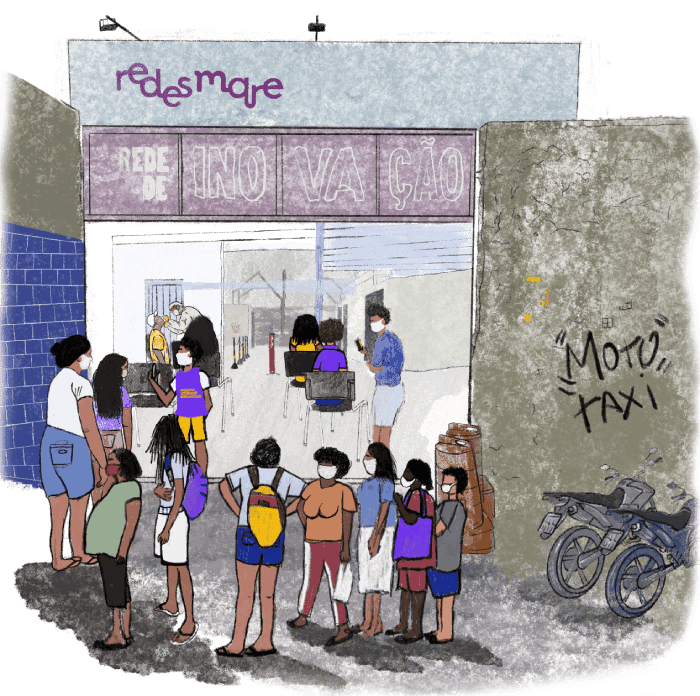
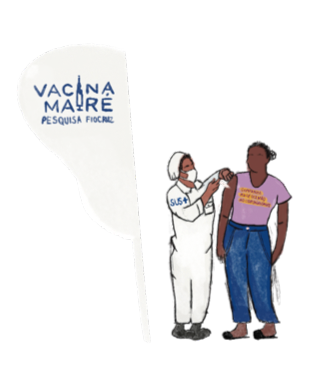
In directly combating the virus, Redes da Maré created the Health Connection project, in partnership with institutions such as Fiocruz. The project ensured testing and telemedicine services, produced informational materials, provided guidance, and developed a safe home isolation program. Furthermore, through extensive mobilization and data production, the foundation was laid for research on vaccine efficacy, securing early vaccination for residents (#VaccineMaré).
To manage such a wide range of actions, it was necessary to reorganize teams and workflows, create a data and logistics system, and establish a virtual service platform. The resources for the campaign came from long-standing partners, new partners, and individual contributions. The campaign lasted almost two years, serving 20,000 families and distributing around 60,000 food baskets and 100,000 meals to homeless individuals. It conducted over 40,000 COVID-19 tests and supported 1,400 people in the safe home isolation program.
The “Maré Says NO to Coronavirus” campaign entered its final phase in mid-2021. At the same time, Redes da Maré was able to resume in-person activities and introduce new areas of work. Based on the lessons learned and the territory’s needs, which were intensified during the pandemic and the campaign, Redes da Maré created a food security initiative and the Right to Health axis.
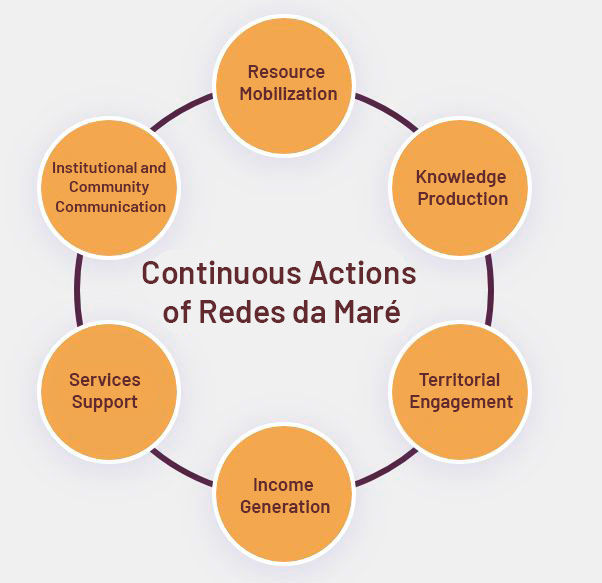
ACTIONS LAUNCHED WITH THE CAMPAIGN

Food Security

Care and Health Practices (prevention and combating coronavirus)

Delivery Logistics

Creation of the Right to Health Axis
TESTIMONIALS
“This campaign was made possible by Redes’ methodology, which involves mobilization, knowledge production, community support, and political influence. Along with its community dimension, which comes from its origin. It was the residents of Maré who created the organization, and its growth has always been rooted in the territory.”
(Camila Barros)
“One of the main outcomes of this campaign was the increased reach of Redes in the territory. Even after 20 years of operation in Maré, there were people who didn’t even know the institution. The work during the pandemic made it more recognized and accessible to more residents.”
(Levi Germano)
“It feels like everything we’ve done up to this point prepared us to face this pandemic in the way we did. It comes from Redes, from the historical path we’ve walked, but also from the fact that I’ve been involved in transformations in Nova Holanda since I was 13..”
(Eliana Sousa Silva)
REDES DA MARÉ:
MAIN CAMPAIGN ACTIONS
Click on the topics to learn about the details of each action carried out.
- Food Security
- Fundraising
- Assistance
- Income Generation
- Delivery Logistics
- Knowledge Production
- Institutional and Community Communication
- Care and Health Practices: Prevention of Coronavirus
- Care and Health Practices: Direct Combat Against Coronavirus
- Territorial Engagement
- Permanent Actions
Food Security
Support actions for food security during the pandemic. Distribution of food baskets, fresh food, cash cards, meals for the homeless population — mainly in areas of drug use — and meals for those infected with COVID-19.
Challenges faced: Selecting families in greater social vulnerability; Creating a database system; Addressing the population's demands and anxieties; Training weavers and volunteers; Educating the population on the limits of civil society actions, and thus, the impossibility of meeting everyone’s needs; Mobilizing public authorities and partners.
Numbers: Approximately 60,000 food baskets and hygiene and cleaning kits distributed, 4,000 people benefited from the cash card, and over 100,000 meals distributed.
Previous experiences: Maré Census; Street Guide; “We are from Maré. We have Rights!” campaign; Assistance for the homeless population at Normal Space; Flavors of Maré.
.
Fundraising
Various funding sources, donations, and support gathered for the campaign’s execution. It involves reallocating resources, securing new contributions from established partnerships, and attracting new ones. Additionally, it includes increasing direct donations from individuals, developing crowdfunding platforms, and collecting direct donations of essential goods such as food baskets, fabrics, cleaning products, and more.
Challenges faced : Ensuring periodic transparency; Meeting the different requirements of funders; Managing the volume of support from diverse sources.
Numbers: 127 supporting partners and hundreds of contributors on crowdfunding platforms.
Previous experience: Structured sectors of Fundraising and Institutional Relations; Communication, Legal, and Administrative-Financial departments; Historical relationship and trustworthiness of the organization with supporters and partners.
Assistance
Social, psychological, and legal assistance offered to the population of Maré. During the campaign, these services expanded to include specific support for COVID-19 cases. Actions included social interviews, virtual services, and proactive outreach to residents.
Challenges faced: Adapting services to a remote format; Creating a virtual service platform; Limited access to public services; Increased support for domestic violence cases; Data qualification for selecting families; Follow-ups on COVID-19 deaths and support for families.
Numbers: 1,789 services in "Maré of Rights" in 2020, 12,486 social interviews, and hundreds of follow-ups by “Normal Space" with the homeless population, 11,000 medical consultations and 3,600 psychological teleconsultations (SAS), and approximately 1,400 COVID-19 cases monitored by "Health Connection" in the home isolation program.
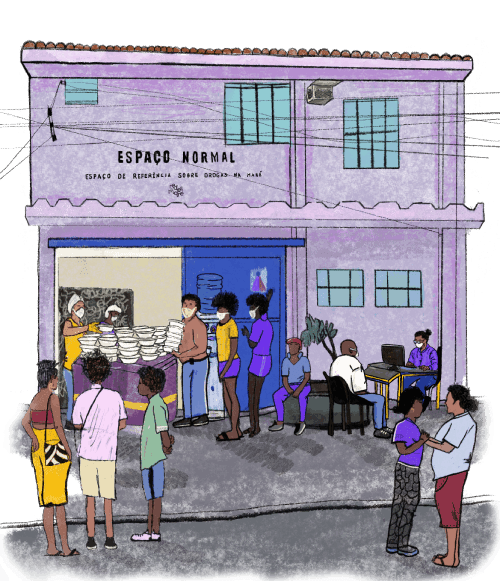
Previous experience: "Maré of Rights" project; Support at "Woman’s House"; "Normal Space" and the establishment of "ATENDA" (comprehensive care for the homeless and drug users); Collaborations with public service networks, other organizations, and universities with extension projects.
Income Generation
Creation of temporary jobs for residents during the most critical phase of the pandemic. These jobs included services provided by seamstresses, drivers, street disinfection agents, and cooks. This initiative also included funding for projects through the “Public Call: New Ways of Making Art, Culture, and Communication in the Favelas,” which supported local communicators and artists.
Challenges faced: Quickly defining necessary projects and actions; Organizing production and delivery logistics; Improving management and accountability; Ensuring COVID-19 protection and promoting training during the initiative.
Numbers:
22 cooks, 54 seamstresses, 13 drivers responsible for donation deliveries, 30 street disinfection agents, 31 grants for communicators and artists.
Previous experience: "Entre Bicos" project (temporary jobs carried out by users of Espaço Normal); "Flavors of Maré" (culinary training for women and the creation of a catering service); Previous public calls and open grants; Consolidated administrative-financial sector; Territorial mobilization processes.
Logistics and Deliveries
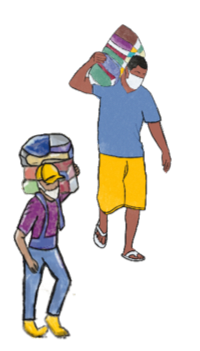
Operational structure for distributing items across the entire Maré Favela Complex during the campaign. This included delivering food, meals, hygiene and cleaning products, Personal Protective Equipment (PPE), books, masks, informational materials, connectivity equipment, and supplies for the “Vacina Maré” initiative.
Challenges faced: Locating unregistered streets; Organizing the multiple stages of each delivery; Managing the logistics, receiving, and loading of thousands of items daily.
Numbers: 1,980 tons of food and hygiene products; 100,000 meals; 47,000 households reached door-to-door with mask and hand sanitizer distribution; 1,000 students received equipment and books. For health units, 280,000 masks, 650 face shields, 255 goggles, 4,240 gowns, 500 gloves, 300 coats, and 179 boxes of alcohol were distributed.
Previous experience: : Maré Census; Street Guide; "Maré de Notícias" and the "We are from Maré. We have Rights!” Campaign.
Knowledge Production about the Territory
Research, data production, content, and information systems to understand the territory and support actions. This included creating a database of families facing food insecurity, tracking COVID-19 cases, producing the "Eyes on Corona" bulletin (content on the pandemic's impacts, prevention, and fight against the virus), research on vaccine effects in partnership with FIOCRUZ, and studies on education during the pandemic.
Challenges faced: Collecting data with pandemic restrictions; Developing a data system while managing distributions; Making information accessible to residents.
Numbers: Data system with 20,000 registered families, 44 "Eyes on Corona" bulletins, monitoring 1,000 families post-COVID, tracking 6,500 people in the AstraZeneca-Fiocruz vaccine effectiveness study, and research with 18 public schools in Maré.
Previous experience: "Maré de Notícias"; Maré Census; Street Guide; Public Security Bulletin and various studies within each area of action.
Institutional and Community Communication
Production and dissemination of information both within and outside Maré. The creation of narratives focused on the strengths of the favela and access to rights. During the campaign, Institutional Communication systematized records, updated the website, produced content for broad dissemination, and maintained dialogue with funders. Community Communication ("Maré de Notícias") produced reports on daily life during the pandemic, spread information, and mobilized the territory (using a sound bike, megaphone, posters on walls, banners, and flyers). Both communication channels were aligned with social media. They also collaborated to produce the podcast “Maré in Times of Coronavirus,” the journalistic text and video series “Inside Maré,” and the “Eyes on Corona” Campaign.
Challenges faced: Spreading a wide range of content in a short period; Responding to social media demands; Collaborating with other teams and ensuring high-quality communication amid “fake news.”
Numbers: 20 episodes of the “Maré in Times of Coronavirus” podcast, over 70 content pieces, a timeline, 10 newsletters, 50 videos about the campaign featuring various participants, monthly publication of "Maré de Notícias" newspaper, dozens of articles on the Maré de Notícias Portal, and on Redes da Maré’s social media and other media outlets.
Previous experience: "Maré de Notícias" newspaper (online and print); Mobilization methodologies and various forms of communication in favelas (word of mouth, street presence, printed materials, media, and social networks); "We are from Maré. We have Rights!" Campaign; Pre-existing communication department structure.
Care and Health Practices: Coronavirus Prevention
COVID-19 prevention and care actions included street disinfection, distributing Personal Protective Equipment (PPE) to health units, providing hand sanitizer, masks, personal hygiene, and cleaning items, supplying local organizations with hand sanitizer dispensers, installing sinks, and sanitizing businesses, churches, and gathering spaces. Additionally, qualified information was disseminated by Maré in partnership with Fiocruz through the “Eyes on Corona” initiative, which produced daily materials in various formats about the pandemic and the virus’s spread in the community.
Challenges faced: Cleaning and disinfecting streets, alleys, and narrow pathways; Raising awareness among residents about prevention practices; Organizing door-to-door deliveries; Adapting to changing health protocols; Producing qualified information in a short time frame.
Numbers: 900 streets, alleys, and narrow pathways disinfected; over 20,000 families benefited with personal hygiene and cleaning kits.
Previous experience: Maré Census, Street Guide, "Maré de Notícias," "Maré of Rights"; pre-existing communication department structure.
Care and Health Practices: Direct Response to Coronavirus
A set of direct actions to combat COVID-19 in the territory. This was carried out through the "Conexão Saúde" project, which included opening a free testing center, supporting safe home isolation, telehealth services (provided by partner SAS Brasil), communication about COVID-19 (community actions and the production of the "Eyes on Corona" bulletin), and mobilizing the "Vacina Maré" campaign.
Challenges faced: Addressing denialism from various government spheres; Supporting health services without replacing public authorities' responsibilities; Circulating safe information about the coronavirus.
Numbers: Over 40,000 tests conducted, approximately 1,400 patients supported in the safe isolation program, 1,828 medical consultations via telemedicine (SAS), 1,046 psychological consultations, and around 37,000 residents vaccinated during the "Vacina Maré" campaign.
Previous experience: Long-standing partnership with Fiocruz; The work of health professionals in Maré since the 1980s; Ongoing dialogue with the Municipal Health and Education Departments; "We are from Maré. We have Rights!" campaign; Activities of Normal Space and collaboration with health and social assistance facilities.
Territorial Engagement
Mobilization and organization efforts with residents and local institutions for collaborative work. The campaign involved volunteers, social organizations, religious groups, residents' associations, among others.
Challenges faced: Organizing volunteers; Ensuring the flow of information; Creating participation spaces; Maintaining ongoing dialogue with partners; Managing conflicts in collective work.
Numbers:
300 individuals involved, including weavers and volunteers; 14 residents' associations; 35 church volunteers; and 26 local partners.
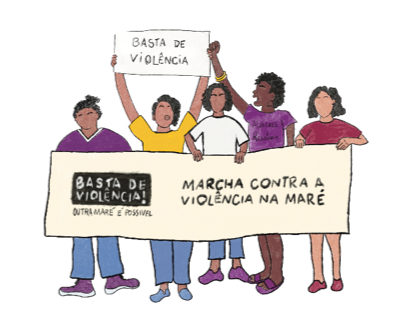
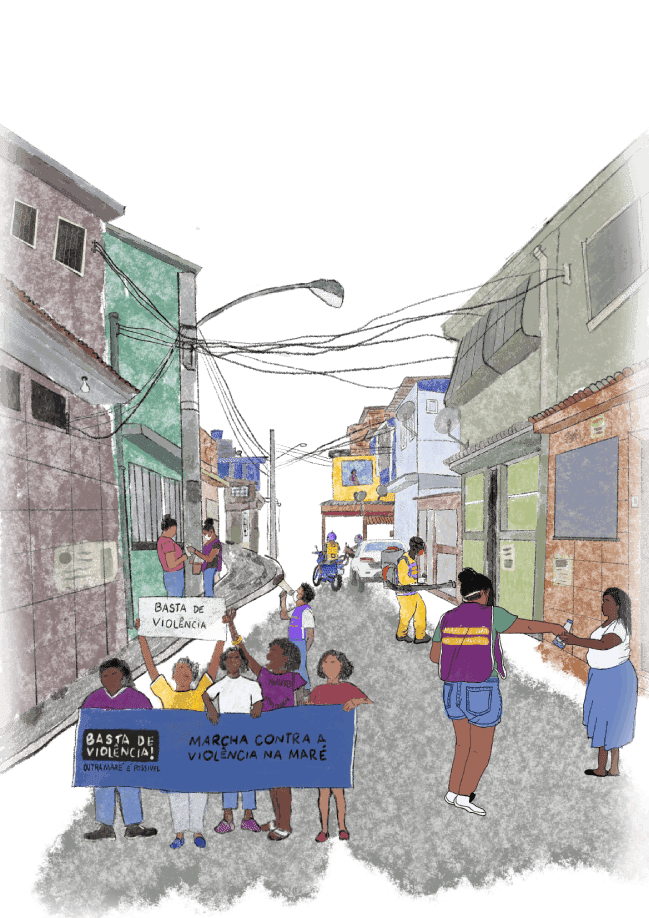
Previous experience: Relationships with residents' associations, churches, collectives, and other NGOs; Collective work in building forums (such as the Drugs Forum, Education Forum, "The Maré we Want" Forum, "Enough of Violence" Forum, etc.); "We are from Maré. We have Rights!" campaign and the March Against Violence.
Permanent Actions
A series of activities across different areas that continued during the pandemic, with adaptations for the health crisis context, including: psychosocial support at the Woman’s House of Maré, ongoing food production by the Maré de Sabores team, drug user support at Normal Space, remote classes at the dance school, virtual activities at the Lima Barreto Library, online assistance from the "Maré of Rights" project, remote classes for pre-university students, the "Write Your Future" literacy project for women, research on the educational situation in Maré during the pandemic, the "Not One Less" project, and Youth and Adult Education (EJA).
Challenges faced: Maintaining the quality of virtual actions despite poor internet service in Maré; Providing support and maintaining connections virtually.
Previous experience: Four established major areas; Six consolidated strategic sectors; The "Redes da Maré" methodology, which prioritizes maintaining connections with beneficiaries and keeping "doors open" in emergency situations within the territory.
REDES METHODOLOGY
The “Maré Says No to Coronavirus” campaign is a combination of continuities and innovations in Redes da Maré’s methodology. The accumulated experiences over its trajectory consolidated and created different fronts of action. We visualize them in this large network, where the campaign’s actions are grouped and represented by circles connected and sustained by Redes Methodology.
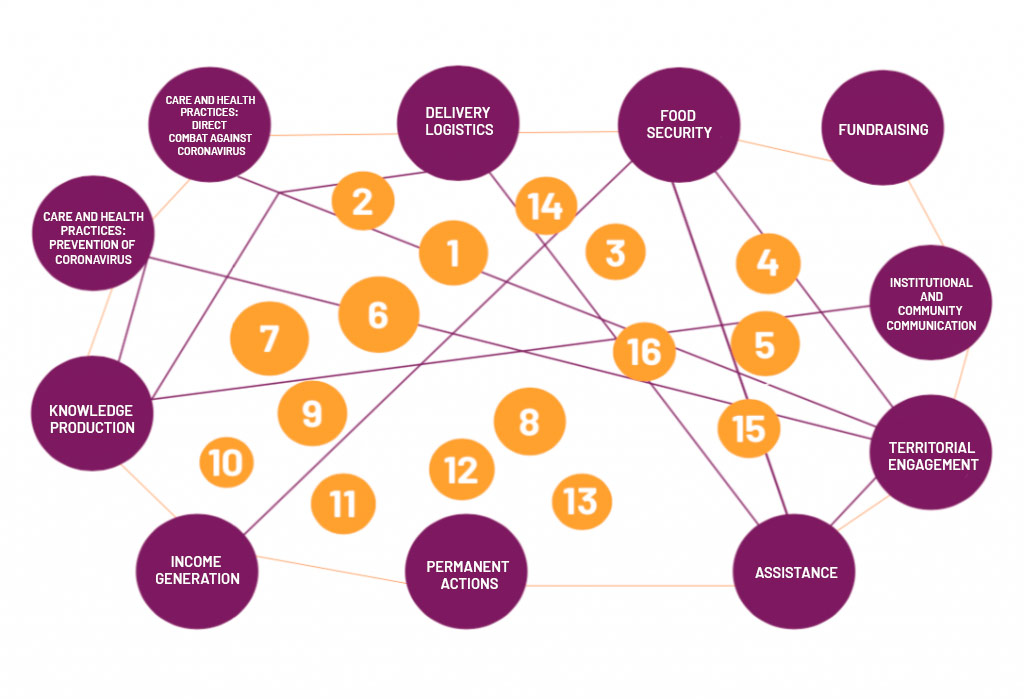
1 . Responses to the territory’s urgencies
2 . Listening to the residents
3 . Commitment and care
4 . Learning by doing
5 . Solid articulation and partnerships
6 . Production of content about the territory
7 . Narratives about Maré’s strengths
8 . Political advocacy for rights
9 . Assistance to the population
10. Collectivity and learning in diversity
11. Territorial mobilization
12. Women’s autonomy
13. Structuring actions
14. Creation and reinvention of practices
15. Maré as a creative force
16. The happiness of “being Redes”
CREDITS

EXECUTION: Redes da Maré
RESEARCH AND CONTENT SYSTEMATIZATION: Marina Praça e Suellen Guariento
LAYOUT: Mascavo
ILLUSTRATION: Weslley Vieira
TEXT REVISION AND TRANSLATION: Soar Soluções Linguísticas
SUPPORT: Fòs Feminista e IACP
Developed by: Webba Desenvolvimento de Sistemas